
Congratulations! This manual guides you through the Nikon D3300’s features, ensuring a rewarding photographic journey. Explore its capabilities and unlock creative potential.
What’s in the Box
Upon unboxing your Nikon D3300, you’ll find the D3300 DSLR camera body itself, ready for photographic adventures. Included is the standard Nikon AF-P DX NIKKOR 18-55mm f/3.5-5.6G VR lens, a versatile starting point. You’ll also receive a battery and charger to power your explorations. A USB cable facilitates image transfer to computers.
Furthermore, the box contains a strap for comfortable carrying, and a comprehensive user manual to guide you through all features. Finally, you’ll find body cap, lens cap, and relevant documentation for registration and warranty information.
D3300 Key Features
The Nikon D3300 boasts a 24.2-megapixel DX-format CMOS sensor, delivering stunning image quality and detail. It features an Expeed 4 image processor for fast performance and reduced noise. Enjoy 11-point autofocus for sharp, accurate shots, and Full HD 1080p video recording capabilities.
Connectivity is enhanced with built-in Wi-Fi for easy image sharing. The camera’s ISO range of 100-25600 allows shooting in various lighting conditions. Its lightweight and ergonomic design ensures comfortable handling during extended use, making it ideal for beginners.
Understanding the Camera Body
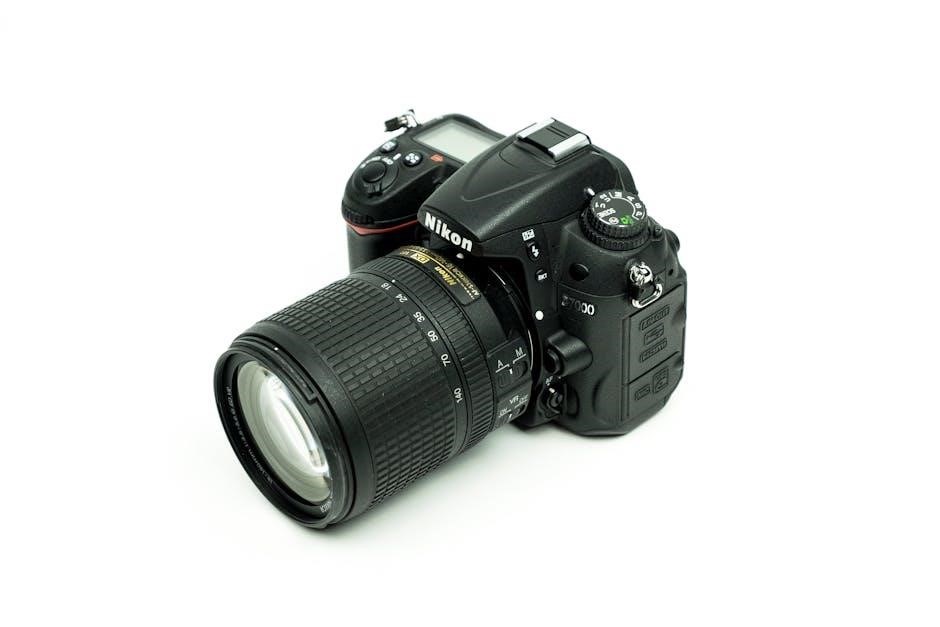
Familiarize yourself with the D3300’s layout, including the grip, lens mount, and essential controls. This knowledge will enhance your shooting experience.
Front and Rear Views
The front of the Nikon D3300 features the lens mount, infrared receiver, and function button. Observe the depth-of-field preview lever and the self-timer/mirror-up button. Turning to the rear, you’ll find the optical viewfinder, mode dial, and control buttons.
Locate the Live View button, the directional pad for menu navigation, and the ‘i’ button for quick settings access. The rear also houses the LCD screen for image review and the speaker. Understanding these placements is crucial for efficient operation and comfortable handling during various shooting scenarios.
Top and Bottom Views
Examining the top of the D3300, you’ll notice the mode dial, offering various shooting options like Auto, Program, Aperture-priority, and Manual. The power switch surrounds the shutter button, and the built-in flash is prominently positioned. On the bottom, discover the battery compartment and the memory card slot, both securely covered.
A tripod socket allows for stable shooting, and various connection ports are neatly arranged. Familiarizing yourself with these top and bottom features enhances accessibility and streamlines your workflow for a more enjoyable photography experience.
Buttons and Dials Explained
The D3300’s controls are intuitively designed for ease of use. The multi-selector navigates menus and selects focus points. The ‘i’ button provides quick access to frequently used settings. Dials control aperture, shutter speed, and exposure compensation, offering precise adjustments.
The function (Fn) button customizes camera operations. The playback button reviews captured images. Understanding each button and dial’s function unlocks full control, allowing you to tailor the camera to your shooting style and capture stunning photographs effortlessly.

Setting Up Your D3300
Begin your photographic journey by properly installing the battery and a compatible memory card. Initial setup guides you through language and date settings.
Inserting the Battery and Memory Card
Powering your D3300 begins with the EN-EL14a rechargeable lithium-ion battery. Locate the battery compartment door on the camera’s bottom. Release the latch and insert the battery, ensuring the contacts align correctly, until it clicks into place.
Next, insert a compatible SD memory card into the SD card slot, also found on the bottom. Push the card in until it clicks. The D3300 supports SD, SDHC, and SDXC cards. Ensure the card is properly seated for reliable operation. Always power off the camera before inserting or removing either the battery or memory card.
Initial Camera Setup
Upon first power-on, the D3300 guides you through essential setup steps. Select your preferred language, date, and time. Confirm the time zone for accurate image timestamps. Next, choose your shooting menu preferences, customizing the camera to your needs.
The setup process also includes selecting image quality and size. Consider shooting in JPEG for immediate use or RAW (NEF) for maximum editing flexibility. Finally, format the memory card to prepare it for storing your photos. This ensures optimal performance and compatibility;
Choosing a Shooting Mode
The D3300 offers diverse shooting modes to suit various scenarios. Auto mode simplifies photography, letting the camera handle all settings. Program (P) mode provides some control while maintaining automatic exposure. Aperture-priority (A) lets you set the aperture for depth of field control, while Shutter-priority (S) controls motion blur.
Manual (M) mode grants full creative control over both aperture and shutter speed. Scene modes, like Portrait or Landscape, optimize settings for specific subjects. Experiment to discover which mode best fits your photographic vision and desired outcome.
Basic Shooting Techniques
Master fundamental skills like focusing, exposure, and flash usage. These techniques are crucial for capturing stunning images with your Nikon D3300.
Focusing Modes and Techniques
Achieving sharp images relies on understanding the D3300’s focusing system. Auto-area AF quickly selects focus points, ideal for general photography. Single-point AF offers precise control, perfect for stationary subjects. Dynamic-area AF tracks moving subjects within a defined area.
Utilize AF-S (single servo) for still subjects and AF-C (continuous servo) for action. Back-button focus, assigned via customization, separates focusing from the shutter release, enhancing control. Experiment with focus lock to recompose your shot after achieving initial focus. Proper technique ensures consistently sharp results.
Understanding Exposure: Aperture, Shutter Speed, and ISO
Mastering exposure is crucial for creative control. Aperture (f-stop) controls depth of field – lower numbers blur backgrounds, higher numbers keep everything sharp. Shutter speed determines motion blur; faster speeds freeze action, slower speeds create blur. ISO adjusts sensor sensitivity – lower ISOs offer cleaner images, higher ISOs perform better in low light but introduce noise.
These three elements work together. Learn to balance them for desired effects. Utilize the exposure compensation dial for fine-tuning brightness in various shooting scenarios.
Using the Built-in Flash
The D3300’s built-in flash provides extra illumination in low-light situations. Press the flash icon button to raise it. Explore flash modes: Auto, Auto with Red-Eye Reduction, Fill-Flash, Slow Sync, and Off. Fill-flash brightens subjects against a bright background. Slow sync combines flash with a slower shutter speed, capturing ambient light and a frozen subject.
Be mindful of potential red-eye; use red-eye reduction or bounce the flash off a ceiling for softer light. Adjust flash compensation for precise control.
Advanced Shooting Features
Unlock your creativity! Explore Picture Control, RAW (NEF) shooting, and versatile Scene Modes for tailored image results and maximum control.
Picture Control Settings
Nikon’s Picture Control system allows you to customize the look of your images directly within the camera. Choose from Standard, Neutral, Vivid, Monochrome, Portrait, Landscape, and Flat settings. Each Picture Control adjusts parameters like sharpness, contrast, brightness, and saturation.
Experiment with these presets to achieve your desired aesthetic without post-processing. You can also create and save custom Picture Controls, fine-tuning individual settings to match your unique style. Access Picture Control settings through the camera menu, offering precise control over image rendering.
Shooting in RAW (NEF) Format
Shooting in RAW (NEF) format captures all the data recorded by the camera’s sensor, offering maximum flexibility in post-processing. Unlike JPEGs, RAW files are uncompressed, preserving detail and dynamic range. This allows for extensive adjustments to exposure, white balance, and color without significant image degradation.
While RAW files require editing in software like Nikon Capture NX-D or Adobe Lightroom, the increased control over your images is invaluable. Enable RAW recording in the camera menu for professional-quality results and greater creative freedom during editing.
Using Scene Modes
Scene Modes simplify photography by automatically optimizing camera settings for specific situations. The Nikon D3300 offers modes like Portrait, Landscape, Sports, and Close-up. These presets adjust aperture, shutter speed, and ISO for optimal results in each scenario.
To access Scene Modes, rotate the mode dial to the “Scene” icon. Select the appropriate mode from the menu, and the camera will handle the technical aspects, allowing you to focus on composition. Experiment with different modes to quickly capture stunning images without manual adjustments.
Working with Lenses
Expand your creativity with compatible Nikon lenses! Understanding lens types—AF-S and AF-P—is key to maximizing your D3300’s photographic potential and versatility.
Compatible Nikon Lenses
The Nikon D3300 boasts excellent compatibility with a wide range of Nikon F-mount lenses, offering photographers diverse options for various shooting scenarios. Specifically, lenses designated with AF-S (Silent Wave Motor) are fully compatible, providing autofocus functionality on the D3300. Older AF-D lenses will also function, but require the camera’s autofocus system to operate.
However, some older lenses might have limited functionality. DX-format lenses are designed specifically for cameras with APS-C sensors like the D3300, providing an optimal field of view. FX-format lenses can also be used, but will result in a narrower field of view due to the crop factor. Always check lens compatibility before purchasing to ensure optimal performance.
Understanding Lens Types (AF-S, AF-P)
Nikon lenses are categorized by their autofocus mechanisms. AF-S lenses utilize Nikon’s Silent Wave Motor, offering quiet and fast autofocus – fully compatible with the D3300. These are a versatile choice for both stills and video. AF-P lenses, a newer type, employ a stepping motor for even smoother and quieter autofocus, particularly beneficial for video recording.
While AF-P lenses generally offer enhanced performance, compatibility with older Nikon bodies is limited. The D3300 fully supports both AF-S and AF-P lenses, providing users with a broad selection. Understanding these distinctions helps photographers choose the right lens for their needs.
Lens Compatibility Considerations
Nikon’s F-mount is consistent across many lenses, but full functionality with the D3300 depends on the lens type. AF-S lenses offer complete compatibility, including autofocus and aperture control. Older AF lenses (without ‘S’) may require manual focusing or limited autofocus capabilities. DX-format lenses are designed specifically for cameras like the D3300, providing optimal image quality.
Using FX (full-frame) lenses on the D3300 is possible, but the camera will automatically crop the image to the DX format. Always check lens compatibility before purchasing to ensure you get the desired performance and features.
Connectivity and Transferring Images
Seamlessly share your photos! Connect the D3300 to a computer via USB, or utilize an optional wireless adapter for smartphone transfers and remote control.
Connecting to a Computer
Establishing a connection between your Nikon D3300 and a computer is straightforward using the supplied USB cable. Ensure your computer is powered on before connecting. The camera will typically appear as a removable drive, allowing you to directly copy images and videos.
Alternatively, you can install Nikon’s software, such as ViewNX-i or Capture NX-D, for enhanced image management and editing capabilities. These programs facilitate importing, organizing, and processing your photographs. Follow the on-screen prompts during software installation to complete the setup process and ensure proper communication between the camera and your computer.
Using Wireless Connectivity (Optional Adapter)
Expanding connectivity, the Nikon D3300 supports wireless transfer via the optional WU-1a Wireless Mobile Adapter. This adapter plugs into the camera’s USB port, enabling communication with smartphones and tablets. Download the Wireless Mobile Utility app (available for iOS and Android) to establish a connection.
Once connected, you can remotely control the camera, view live previews, and instantly transfer images for sharing. The adapter facilitates convenient image backup and social media uploads. Ensure the adapter is properly installed and the app is configured correctly for seamless wireless operation;
Transferring Images to a Smartphone
Seamless sharing is enabled by connecting your Nikon D3300 to a smartphone using the optional WU-1a Wireless Mobile Adapter and the Wireless Mobile Utility app. After establishing a wireless connection, select images on the camera and choose the transfer option within the app.
The app allows for individual or batch image transfers. Ensure both devices are within range and the app has necessary permissions. Alternatively, you can transfer images by removing the memory card and using a card reader connected to your smartphone. This provides a direct and rapid transfer method.
Troubleshooting Common Issues
Encountering problems? This section addresses frequent concerns like camera power failures, focusing difficulties, and deciphering error messages for swift resolution.
Camera Not Turning On
If your Nikon D3300 fails to power on, begin by verifying the battery is correctly inserted and fully charged. Try a different, known-good battery if available. Ensure the battery compartment door is securely closed, as a faulty latch can prevent operation.
Next, inspect the battery contacts for any dirt or corrosion, cleaning them gently with a soft, dry cloth. Confirm the power switch is set to the ‘ON’ position. If the issue persists, reset the camera by removing the battery and memory card for several minutes before reinserting them.
A flashing green light on the charger indicates a potential charging issue; try a different charger or contact Nikon support.
Focusing Problems
Experiencing focusing issues with your Nikon D3300? First, ensure you’ve selected the appropriate focus mode (Auto-area, Single-point, etc.) for your subject and shooting situation. Verify sufficient light is available, as low light can hinder autofocus performance. Clean the lens carefully, as smudges can interfere with focusing accuracy.
Try switching between AF-S and AF-C focus modes to see if one performs better. If using autofocus, half-press the shutter button to initiate focusing and confirm the focus point illuminates. If manual focus is selected, rotate the focusing ring until the image appears sharp in the viewfinder.
Error Messages and Solutions
Encountering error messages on your Nikon D3300? “Err” blinking often indicates a mechanical issue; turn the camera off and on. A battery symbol suggests low power – replace or recharge the battery immediately. “Card full” requires inserting a new memory card or deleting existing files. “No memory card” means a card isn’t detected; reinsert it securely.
If you see a lens error, detach and reattach the lens, ensuring proper connection. Consult the camera’s manual for specific error code explanations and troubleshooting steps. Resetting the camera to factory defaults can sometimes resolve persistent errors.

Maintaining Your D3300
Protect your investment! Regularly clean the sensor, care for the battery, and store your D3300 properly to ensure longevity and optimal performance.
Cleaning the Sensor
Dust on the sensor can degrade image quality. Nikon recommends using a blower to remove loose particles first. If spots persist, utilize a sensor cleaning kit – specifically designed for DSLR sensors – with extreme caution;
Always fully charge the battery before initiating sensor cleaning. Access the sensor cleaning mode within the camera’s menu. Gently sweep the sensor with the cleaning swab, following the kit’s instructions precisely. Avoid applying excessive pressure.
Professional cleaning is advisable if you’re uncomfortable performing this task yourself, as improper cleaning can damage the sensor. Regular preventative maintenance minimizes the need for frequent cleaning.
Battery Care
Maximize your Nikon D3300’s battery life by following these guidelines. Use only Nikon-approved chargers and batteries to prevent damage. Avoid extreme temperatures – both heat and cold can reduce battery performance.
When storing the camera for extended periods, remove the battery to prevent potential leakage or corrosion. Fully charge the battery before long trips or shoots. Avoid repeatedly interrupting charging cycles; allow the battery to fully charge before use.
Proper storage and mindful usage significantly extend battery lifespan, ensuring reliable performance during your photographic adventures.
Storage and Handling
Protect your Nikon D3300 from damage by storing it in a clean, dry place, away from direct sunlight and dust. When transporting the camera, use a padded camera bag or case to cushion against impacts. Avoid dropping or subjecting the camera to strong vibrations.
Keep the camera body and lens clean by using a soft, lint-free cloth to wipe away dust and fingerprints. Avoid using harsh chemicals or abrasive cleaners. Store lenses with the rear cap attached to prevent dust accumulation.
Careful handling and proper storage will ensure your D3300 remains in excellent condition for years to come.
Nikon Software and Accessories
Enhance your workflow with Nikon Capture NX-D and ViewNX-i software. Explore optional accessories like speedlights and tripods for expanded creativity!
Nikon Capture NX-D and ViewNX-i
Nikon Capture NX-D is a powerful image editing software specifically designed for Nikon cameras, including the D3300. It allows for non-destructive editing of NEF (RAW) files, preserving original image data. You can adjust exposure, white balance, and color with precision.
ViewNX-i serves as a versatile image browser and basic editor. It’s ideal for quickly viewing, organizing, and performing simple adjustments to your photos. Both programs offer seamless integration, enabling efficient workflow from capture to post-processing. Download these essential tools from Nikon’s official website to fully utilize your D3300’s potential.
Recommended Accessories (Speedlights, Tripods)
Enhance your D3300 experience with compatible accessories! A Nikon Speedlight, like the SB-400, provides versatile off-camera flash capabilities, improving image quality in challenging lighting. For sharp, stable shots, a sturdy tripod is essential, especially for landscapes or low-light photography.
Consider a remote shutter release to minimize camera shake during long exposures. Additional batteries and memory cards are also practical investments. Explore Nikon’s range of accessories or compatible third-party options to expand your creative possibilities and maximize your D3300’s potential.
Updating Camera Firmware
Keep your Nikon D3300 performing optimally by regularly updating its firmware. Nikon periodically releases firmware updates to improve performance, add features, and address potential bugs. Download the latest firmware from the Nikon website and follow the provided instructions carefully.
Typically, this involves formatting a memory card, copying the firmware file, and powering on the camera in a specific mode. Do not interrupt the update process, as this could damage your camera. Regularly checking for updates ensures you benefit from the latest enhancements.